








President William Ruto will headline East Africa’s biggest US trade gathering next month, as Kenya pushes to lock in billions of shillings in fresh commercial deals. The 5th regional AmCham Business Summit runs September 9 and 10 at Windsor Golf Hotel in Nairobi, and this time small businesses have a genuine reason to pay attention too.
The summit arrives just weeks after the US extended AGOA duty-free access through December 2028, giving Kenyan exporters a rare, predictable window to plan around. For small and medium enterprises, that window is worth understanding now.
What’s Happening and When
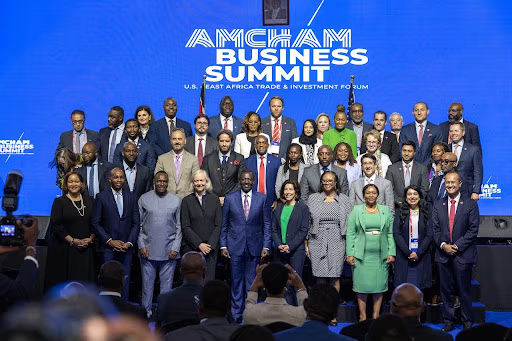
Windsor Golf Hotel and Country Club hosts the two-day summit, organized by AmCham Kenya and the US Embassy, and co-hosted by Kenya’s Ministry of Investments, Trade and Industry. The event was confirmed this week, with AmCham Kenya Board President Angela Ng’ang’a saying Ruto’s presence sends a clear signal to investors weighing Kenya against other markets.
Regional AmCham chapters from Uganda, Tanzania, Rwanda, and Ethiopia are joining, alongside the US Chamber of Commerce, Invest Kenya, and the US Trade and Development Agency. Past editions have pulled in more than $2 billion in tracked investment commitments, according to reporting from The Kenyan Wall Street.
| Detail | Information |
|---|---|
| Dates | September 9-10, 2026 |
| Venue | Windsor Golf Hotel & Country Club, Nairobi |
| Chief Guest | President William Ruto |
| Theme | Advancing Mutual Prosperity Through Trade and Investment |
| Co-Conveners | AmCham Kenya, US Embassy Kenya, Ministry of Investments, Trade and Industry |
Day two opens with a presidential address, followed by a fireside chat on investment commitments and regulatory certainty, then an expo tour. The night before, AmCham co-hosts an invitation-only investors dinner with The Kenyan Wall Street.
Seven Sectors Under the Spotlight
Organizers built the agenda around seven industries: digital economy, critical minerals, energy and infrastructure, agriculture, manufacturing, healthcare, and the creative economy. Two of those carry outsized weight this year.
Kenya is chasing $250 to $300 million in AI infrastructure investment, according to the Kenyan Wall Street’s coverage. Critical minerals talks will center on Mrima Hills, where rare earth deposits are valued at $41.7 billion, a figure that has drawn serious international attention to the coastal region.
Why the AGOA Timing Matters
The African Growth and Opportunity Act now runs through December 31, 2028, after the US Senate approved the extension. Coverage from Ghanamma notes the extension keeps the third-country fabric provision intact, letting Kenyan manufacturers source yarn and fabric elsewhere, sew garments locally, and still export duty-free to the US.
Flower, coffee, tea, and macadamia exporters stand to benefit too, since the extension preserves their preferential access alongside the apparel sector’s.
The Real Opportunity for Small Businesses
AGOA covers more than 6,000 products, but most Kenyan small business owners have never seriously considered exporting under it. That’s largely because the apparel giants dominate the conversation, and the compliance side feels intimidating from the outside.
AmCham exists partly to close that gap. It runs matchmaking through Deal Rooms and apps like Brella, pairing small suppliers directly with US buyers hunting for distributors, raw materials, or niche components, rather than making businesses find their own way in cold.
On compliance, AmCham works with the US Embassy and the Export Processing Zones Authority to run workshops on customs rules of origin and safety standards. For anyone shipping fresh produce or flowers, the joint US-Kenya Cold Chain Initiatives help align operations so shipments actually clear US inspection rather than getting turned back.
Funding is the other piece. AmCham links smaller exporters to development finance institutions and microfinance programs that can bridge the gap between current production and US order volumes. Manufacturing inside an Export Processing Zone adds another layer of relief, with exemptions on VAT and customs duty for raw inputs.
The strongest openings for small operators sit outside apparel entirely: specialty foods like macadamia nuts, dried fruit, and organic honey; beadwork, leather goods, and other artisanal crafts; and niche agriculture such as specialty tea, coffee, and fresh herbs.
What This Means Beyond the Summit
Investment channeled through AmCham members has historically created more than 26,000 formal jobs in Kenya in past cycles. The chamber also runs training tied to global tech firms, opening remote work and digital export paths for younger, English-speaking workers.
None of that happens automatically from a two-day conference. It happens when businesses actually show up, register for the matchmaking sessions, and follow through on the introductions made there.
Also read:Best Business Opportunities in Kenya (2026)
Frequently Asked Questions
When and where is the AmCham Business Summit 2026?
September 9 to 10, 2026, at Windsor Golf Hotel and Country Club in Nairobi.
How long has AGOA been extended?
Through December 31, 2028, giving Kenyan exporters a fixed window of duty-free US access.
Can small businesses attend?
Yes. MSMEs can register for B2B matchmaking and Deal Room sessions built specifically to connect smaller suppliers with US buyers.
What products qualify for duty-free access under AGOA?
Over 6,000 products, including apparel, specialty foods, home décor, and tea, with strong openings in niche categories like macadamia nuts and handmade crafts.
How much has AmCham generated in past summits?
More than $2 billion in tracked investment commitments across previous editions.
Conclusion
The AGOA extension buys Kenyan exporters time and certainty they haven’t had in years. What happens with that window now depends less on Washington or Nairobi’s negotiators and more on whether small business owners actually walk through the doors AmCham is opening for them.