








Kenyan consumers are feeling a fresh squeeze on milk prices after formal-sector deliveries fell sharply in June. Kenya National Bureau of Statistics data cited by the Consumers Federation of Kenya shows processors and other formal buyers took in 84.44 million litres in June 2026, down 5% from 88.89 million litres in May.
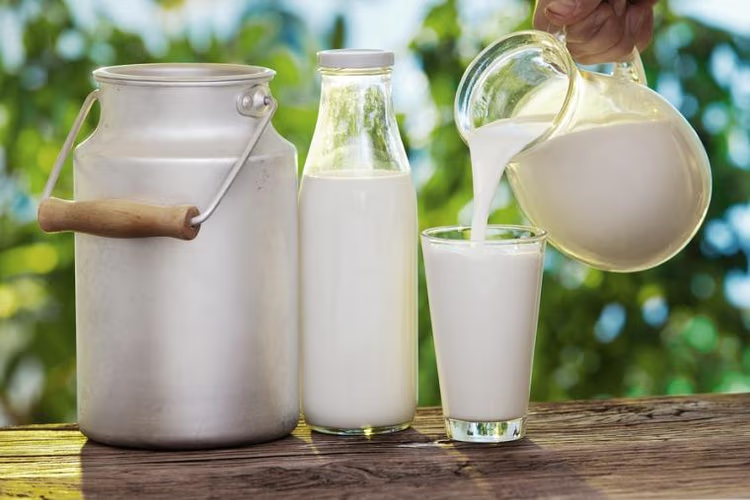
Formal milk intake fell 5% in June 2026, with COFEK warning of intermittent supermarket shortages and rising fresh-milk prices in Nairobi.
The June figure was also 6.4% lower than the 90.24 million litres recorded in June 2025. Cumulative intake for January to June 2026 stood at 513.32 million litres, almost flat against 516.34 million litres in the same period of 2025. Monthly volumes have been volatile, with February’s 74.43 million litres the weakest month so far this year.
COFEK says the tighter formal supply is already showing up in Nairobi. Some retailers have started rationing purchases. Fresh unpacketed milk at Waithaka Dairy Centre has risen from KSh 70 to KSh 80 a litre. Branded packaged milk has become intermittently scarce on supermarket shelves.
What is Driving the Squeeze
Smallholder farmers supply about 80% of Kenya’s milk. COFEK reports that some of them have seen daily yields drop from seven to nine litres per cow to four or five litres. Delayed rains have weakened pasture. Commercial feed costs have risen by roughly 45%, according to the federation.
Feed is the largest cost for most dairy herds. When pasture fails and bagged dairy meal jumps in price, production falls quickly. Farmers absorb the loss first. Some sell animals or leave the business. The Kenya Dairy Board has previously acknowledged that high feed costs can push producers out of dairy farming.
COFEK also argues that the sector entered the dry spell with thin buffers. It says milk powder from the strong 2025 season was not properly locked into strategic reserves. That left processors and retailers more exposed when formal deliveries weakened in 2026.
National production hit a high of about 5.5 billion litres in 2025, with formal processor intake crossing the one-billion-litre mark for the first time. The contrast between that surplus year and the current monthly dips is what has sharpened the consumer warning.
Price Pressure on the Shelf
Retail effects are uneven. Unpacketed fresh milk has moved up more clearly in some distribution points. Packaged brands have faced intermittent gaps rather than a uniform nationwide stock-out. Reports of empty or limited shelves for popular brands have circulated in Nairobi, but the clearest verified price move remains the KSh 70 to KSh 80 shift at Waithaka.
Farmers sit on the other side of the same squeeze. Farm-gate prices have not risen in line with feed and transport costs. High cooperative loan servicing and fuel expenses further cut into margins. The result is a classic dairy mismatch: consumers pay more while many producers still struggle to cover feed bills.
| Metric | Figure |
|---|---|
| Formal intake – May 2026 | 88.89 million litres |
| Formal intake – June 2026 | 84.44 million litres |
| Month-on-month change | –5.0% |
| June 2026 vs June 2025 | –6.4% (from 90.24 million litres) |
| Lowest month H1 2026 | February: 74.43 million litres |
| H1 2026 cumulative | 513.32 million litres |
| Fresh milk (Waithaka example) | KSh 70 → KSh 80 per litre |
COFEK’s Seven-Day Demands
On 31 August 2026, COFEK issued a clear set of asks. The federation wants the Ministry of Agriculture to publish a recovery plan within seven days. That plan should include monthly milk-intake targets and emergency fodder and feed support for the worst-hit dairy counties.
It wants the Kenya Dairy Board to explain what happened to the 2025 surplus and the status of any powder reserves, and to put a standing surplus-absorption and strategic-reserve system in place.
It also wants the National Treasury to waive import duty and VAT on yellow maize, soya and other key dairy-meal ingredients. The goal is to cut feed costs and stop more farmers from exiting.
These are advocacy demands, not government policy announcements. They set a public timeline and put pressure on the institutions that control fodder support, reserves and import taxes.
Why the Value Chain Keeps Breaking
Kenya’s dairy market is split. A large informal channel still moves a big share of raw milk. Formal processors capture a growing but still limited slice. When pasture fails, both channels feel it, but supermarket shelves empty first because they depend on formal collection, processing and distribution.
Feed costs sit at the centre. Commercial dairy meal can account for the bulk of a farmer’s cash outlay. When that cost rises 45% while farm-gate prices lag, production falls. Processors then receive less milk. Retailers ration. Consumers pay more or switch to unpacketed milk of uneven quality.
Read also:Apollo Agriculture — Farm Inputs, Loans & Insurance for Farmers | Business Listings Kenya
The 2025 surplus showed the opposite problem: strong rains, high production, and pressure on processors to mop up milk without enough powder or long-life capacity. COFEK’s point is that neither the glut nor the shortage has been managed with a durable buffer.
What Consumers and Farmers Can Watch
The next clear signals will be:
- July and August formal intake figures from KNBS or the Kenya Dairy Board
- Whether the Ministry of Agriculture publishes any recovery targets
- Any temporary duty relief on feed ingredients
- Movement in farm-gate prices versus retail packet prices
- Whether major processors restore regular shelf presence of branded 500 ml packs
Until production recovers or buffers are rebuilt, price and availability will remain sensitive to rainfall and feed costs. Smallholders remain the backbone of supply. If more of them sell animals or cut herds, the formal shortfall will not reverse quickly.
Sources
- allAfrica / Capital FM – Consumers warn of milk price squeeze as formal supply falls
- The Eastleigh Voice – COFEK demands urgent action as milk shortages and prices spike
- Kenyans.co.ke – COFEK sets seven-day deadline for government to address milk crisis
- COFEK statement citing KNBS Leading Economic Indicators, June 2026 (formal intake table)
- Earlier KNBS / Kenya Dairy Board reporting on 2025 production and formal intake records