



The Stanbic Money Market Fund (KES) is paying an effective annual yield of 5.38 percent before tax, according to Stanbic’s website on November 7, 2026. That is about 4.57 percent after the 15 percent withholding tax for a taxable resident individual, well below October’s 7.3 percent inflation rate and below the 9.13 percent average yield across 27 Kenyan shilling money market funds.
- Stanbic Money Market Fund at a glance
- What the Stanbic Money Market Fund yields now
- How the yield has changed since launch
- Performance against its benchmark
- What the fund invests in
- Regulation and size: what CMA data shows
- How Stanbic compares with other money market funds
- Inflation and what the yield buys
- How safe is the Stanbic Money Market Fund?
- Fees and tax
- How to invest and withdraw
- Sources
The fund is approved by the Capital Markets Authority (CMA) and managed by SBG Securities Limited. This guide sets out what it holds, what it costs, how it has performed against its benchmark and how to invest, using Stanbic’s fact sheet, CMA data and current market rates.
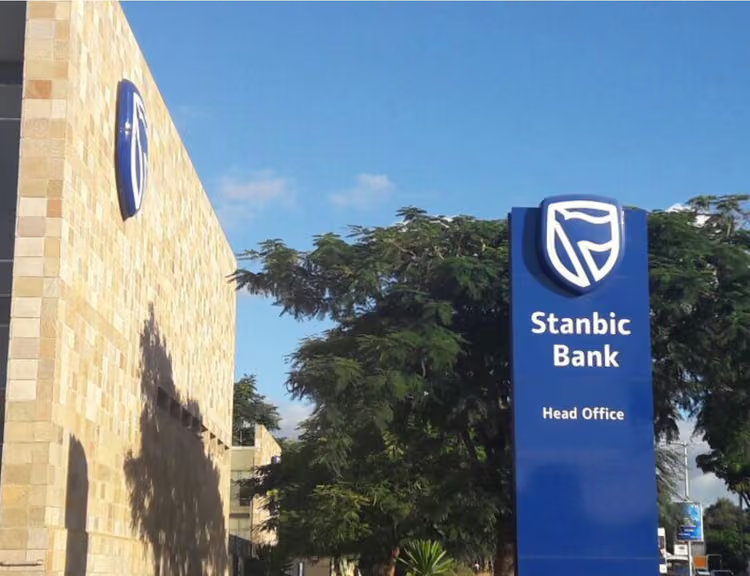
Stanbic Money Market Fund at a glance
The details below come from the fund’s September 2026 fact sheet unless stated otherwise.
| Feature | Detail |
|---|---|
| Fund manager | SBG Securities Limited, a subsidiary of Stanbic Holdings Plc |
| Regulator | Capital Markets Authority (CMA) |
| CMA scheme | Stanbic Unit Trust Funds |
| Launch date | July 2024 |
| Trustee | KCB Bank Kenya Limited |
| Custodian | Standard Chartered Bank Kenya Limited |
| Auditor | Deloitte Kenya |
| Minimum investment and top-up | Sh1,000 each |
| Management fee | 2 percent a year plus VAT |
| Benchmark | Three-month average of the 182-day Treasury bill rate |
| Fund size (end of September 2026) | Sh1.74 billion |
| Income | Calculated daily, paid or reinvested monthly |
What the Stanbic Money Market Fund yields now
Stanbic’s website shows a daily rate of 5.25 percent and an effective annual rate of 5.38 percent. The fund’s monthly average effective annual yield for September 2026 was 5.34 percent.
The fact sheet says returns are net of fees and other expenses but gross of withholding tax. Taking 15 percent off 5.38 percent gives about 4.57 percent.
On a Sh100,000 investment held for a year at today’s rate, that is about Sh5,380 before tax and about Sh4,573 after tax. Rates change daily, so this is an illustration, not a forecast.
How the yield has changed since launch
Stanbic launched the fund publicly in September 2024 with a quoted annualised yield of 15.12 percent. The January 2025 fact sheet showed a monthly average effective yield of 9.97 percent.
The September 2026 fact sheet lists a highest historical yield of 17.35 percent and a lowest of 5.00 percent, without giving dates.
Performance against its benchmark
The fund’s benchmark is the three-month average of the 182-day Treasury bill rate. In every period Stanbic reports, the fund has trailed it.
| Period | Stanbic MMF | Benchmark | Gap (percentage points) |
|---|---|---|---|
| September 2026 (monthly average, annual effective yield) | 5.34% | 8.92% | 3.58 |
| Year to date (January to September 2026) | 5.44% | 8.33% | 2.89 |
| Since inception (July 2024) | 7.84% | 9.89% | 2.05 |
Fund figures are net of fees and other expenses and gross of 15 percent withholding tax. The Treasury bill benchmark carries no fees. The fact sheet does not say whether the year-to-date and since-inception figures are cumulative or annualised, so read them as Stanbic’s reported returns for each period, not as a like-for-like annual rate.
What the fund invests in
Stanbic says the fund aims for stable income and capital preservation by investing in high-quality bank deposits, Treasury securities and corporate debt in Kenya. At the end of September 2026, the holdings were:
- 46.72 percent in Kenya government securities (45.57 percent Treasury bills and 1.15 percent Treasury bonds)
- 44.74 percent in fixed deposits
- 8.54 percent in cash and call deposits
The weighted average duration was 0.3 years. In January 2025, fixed deposits made up 75.70 percent of the fund and Treasury bills 15.14 percent, so the mix has shifted toward government paper.
Regulation and size: what CMA data shows
CMA’s collective investment schemes report for the quarter ended June 30, 2026 lists 66 approved schemes comprising 320 funds, of which 47 are active. Stanbic Unit Trust Funds is one of the 47 reporting schemes, with total assets of Sh6.99 billion.
The CMA table of money market funds shows the Stanbic Money Market Fund at Sh1,983,382,084 on June 30. That ranks it 29th of 59 money market funds by size, about 0.4 percent of the Sh459.9 billion held in money market funds. The table includes dollar funds.
The fund has since shrunk. Stanbic’s fact sheet puts it at Sh2.36 billion in January 2025 and Sh1.74 billion at the end of September 2026.
How Stanbic compares with other money market funds
Rate tracker Serrari Group’s index of 27 Kenyan shilling money market funds showed an average yield of 9.13 percent in early November 2026. Its top three funds were Cytonn at 11.11 percent, Faulu at 10.82 percent and Lofty Corban at 10.62 percent.
| Fund | Gross yield | Net after 15% tax |
|---|---|---|
| Stanbic Money Market Fund | 5.38% | About 4.57% |
| Index average (27 funds) | 9.13% | About 7.76% (calculated) |
| Cytonn Money Market Fund | 11.11% | 9.44% |
| Faulu Money Market Fund | 10.82% | 9.20% |
| Lofty Corban Money Market Fund | 10.62% | 9.03% |
Stanbic’s figure is from its own website on November 7. The other rates are from Serrari’s table in the first week of November and change daily. In Serrari’s October 21 comparison, Stanbic ranked 27th of 27 funds, 3.21 percentage points below the market’s average net yield.
Treasury bills also pay more than the fund. At the Central Bank of Kenya’s October 29 auction, the 91-day bill averaged 8.7498 percent, the 182-day 8.8508 percent and the 364-day 9.0288 percent. The Central Bank Rate is 8.75 percent.
Inflation and what the yield buys
Kenya’s annual inflation rose to 7.3 percent in October 2026 from 6.8 percent in September, according to the Kenya National Bureau of Statistics. It was the highest reading since July 2023.
A net yield of about 4.57 percent is roughly 2.7 percentage points below that. In plain terms, the interest earned would not keep pace with price increases at the current inflation rate.
How safe is the Stanbic Money Market Fund?
The fund is a CMA-approved collective investment scheme. Its assets are overseen by an independent trustee, KCB Bank Kenya, and held by a custodian, Standard Chartered Bank Kenya, and the accounts are audited by Deloitte.
The custodian has changed. The January 2025 fact sheet named Stanbic Bank Kenya Limited, while the September 2026 sheet names Standard Chartered Bank Kenya Limited.
Regulation does not guarantee returns or capital. The fact sheet states that the investment value may go up or down, that the manager gives no guarantee on capital or return, and that redemption rights may be suspended in specified circumstances. About 45 percent of the fund sits in fixed deposits, and investors can read Stanbic’s published financial statements to see the banks involved.
Fees and tax
The management fee is 2 percent a year plus VAT. It is already reflected in the quoted yield, so investors do not pay it separately.
Interest is subject to 15 percent withholding tax, and the fact sheet labels the fund’s returns as gross of it. Stanbic’s September 2026 fact sheet, issued after the Finance Act 2026 took effect on July 1, still describes returns this way.
Read also:Co-op Money Market Fund Kenya: Rates, Fees and How to Invest (2026 Guide)
The 4.57 percent figure assumes a taxable resident individual. The Kenya Revenue Authority says withholding tax is final for residents on qualifying interest, and tax advisers generally treat money market fund interest paid to individuals as qualifying. For companies and other non-individual investors, withholding tax is usually not final, so they may need to declare the interest and claim the tax withheld as a credit.
Stanbic’s onboarding checklist includes a tax exemption certificate for investors it applies to. Anyone who holds one should ask Stanbic how it affects their returns, and confirm their own position with KRA or a tax adviser.
How to invest and withdraw
The minimum is Sh1,000, with top-ups from Sh1,000. Stanbic’s head of asset management has said investors can start through the Stanbic mobile app, the *208# USSD code or any branch. The application form can be emailed or dropped at a branch.
For individual and joint accounts, Stanbic lists these documents:
- A copy of the national ID or passport and a coloured passport photo
- A copy of the KRA PIN certificate
- Proof of banking details, such as a copy of a debit card, a certified bank statement not older than three months or a cancelled cheque
- A tax exemption certificate, if applicable
To withdraw, individual and joint account holders can dial *208# and choose menu option 9. Others, including companies, NGOs and churches, must submit a redemption form at a branch. Stanbic says proceeds reach the nominated bank account within two working days. Requests received after 9:00 a.m. East Africa Time are priced the next day.
Stanbic describes the fund as suitable for beginners and for building an emergency fund, normally three to six months of expenses. Investors should also read the fund’s information memorandum and the Deed of Variation and related memorandum that Stanbic published on July 30, 2026.
This article is general information and not financial, tax or investment advice. Yields change daily and past performance does not predict future returns. Read the fund’s information memorandum and latest fact sheet, and consider speaking to a licensed adviser, before investing.
Sources
- Stanbic Unit Trust Fact Sheet, September 2026, SBG Securities
- Stanbic Asset Management rates, financial statements and fund documents, SBG Securities
- Stanbic Money Market Fund Fact Sheet, January 2025, Stanbic Bank Kenya
- Stanbic Money Market Fund product page, Stanbic Bank Kenya
- Stanbic Money Market Fund required documents and redemption terms, Standard Bank
- Kenya investors are rethinking options for better returns, Business Daily (Stanbic head of asset management)
- Collective Investment Schemes Quarterly Report, quarter ended June 30, 2026, Capital Markets Authority
- CMA register of approved collective investment schemes (as referenced in the CMA report)
- Stanbic Bank targets investors with new money market funds, Capital FM
- Money market funds in Kenya ranked by yield, Serrari Group
- Cytonn MMF vs Stanbic MMF comparison, Serrari Group (October 21, 2026)
- Treasury bill auction results dated November 2, 2026, Central Bank of Kenya
- Kenya’s inflation rises to 7.3% in October, Citizen Digital (KNBS data)
- Everything about Withholding Tax, Kenya Revenue Authority
- Withholding Tax in Kenya 2026, FNJ Associates
- Finance Act, 2026, Kenya Revenue Authority