
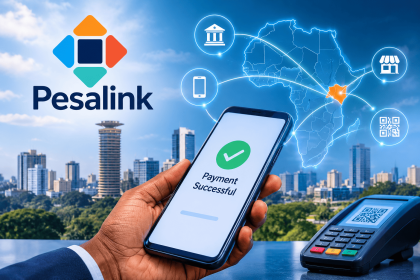




Kenya’s instant payment system Pesalink has attained basic inclusivity status in the AfricaNenda Foundation’s 2026 State of Inclusive Instant Payment Systems (SIIPS) report, moving from unranked in 2025 after launching direct merchant payment services.
The upgrade places Pesalink among 19 African instant payment systems now rated at the basic level, according to the report released in partnership with the World Bank Group and the United Nations Economic Commission for Africa. Nigeria’s NIBSS Instant Payment remains the continent’s only mature system.
What Drove the Upgrade
AfricaNenda ranks systems on an inclusivity spectrum that runs from Not Ranked to Basic, Progressed and Mature. To reach the basic tier, a system must support both person-to-person transfers and person-to-business (P2B) merchant payments on the channels most used in its market.
Pesalink crossed this threshold by introducing direct retail payment channels that allow consumers to pay merchants via till numbers, paybills and QR codes. It also expanded participation by onboarding mobile money operators such as Airtel Money and other non-bank payment service providers, enabling direct interoperability between bank accounts and mobile wallets.
The system is operated by Integrated Payment Services Limited (IPSL), a company owned by the Kenya Bankers Association. In recent months it has promoted lower-cost transfers, including free transactions of up to KSh 1,000 and a flat KSh 20 fee for larger amounts on participating banks.
Gaps Remaining for Higher Tiers
Despite the progress, Pesalink remains at the basic level while Tanzania’s TIPS, Rwanda’s eKash and Mauritius’s MauCAS sit in the Progressed tier. The AfricaNenda report notes that Pesalink is otherwise close to progressed status, but governance gaps hold it back.
Non-bank participants do not appear to have representation in scheme governance, and the Central Bank of Kenya has no direct involvement in scheme-level decision-making. Full interoperability that places banks, telcos and fintechs on equal footing, broader use cases such as government and cross-border payments, low and transparent fees, and formal consumer dispute-resolution mechanisms are among the requirements for advancing further.
Implications for Kenya’s Payments Market
The introduction of till and paybill functionality positions Pesalink as a more direct competitor to M-Pesa in the merchant payments space. For businesses and consumers, wider account-to-account merchant options could increase choice and put downward pressure on transaction costs over time.
Read also:ABC Bank PesaLink Fees 2026: Free Below KSh 1,000, KSh 20 Flat Rate
However, the governance structure controlled by the Kenya Bankers Association means non-bank players currently have limited influence over scheme rules. Closing that gap, together with deeper Central Bank of Kenya oversight at scheme level, will determine how quickly Pesalink can move beyond basic inclusivity and whether it becomes a true industry-wide infrastructure rather than primarily a bank-led rail.