






The Directorate of Criminal Investigations (DCI) has warned Kenyans against online fraudsters who pose as successful forex, cryptocurrency and digital investment mentors. The alert, publicised on 28 September 2026, targets people who flaunt “easy money” lifestyles on social media to pull victims into scams.
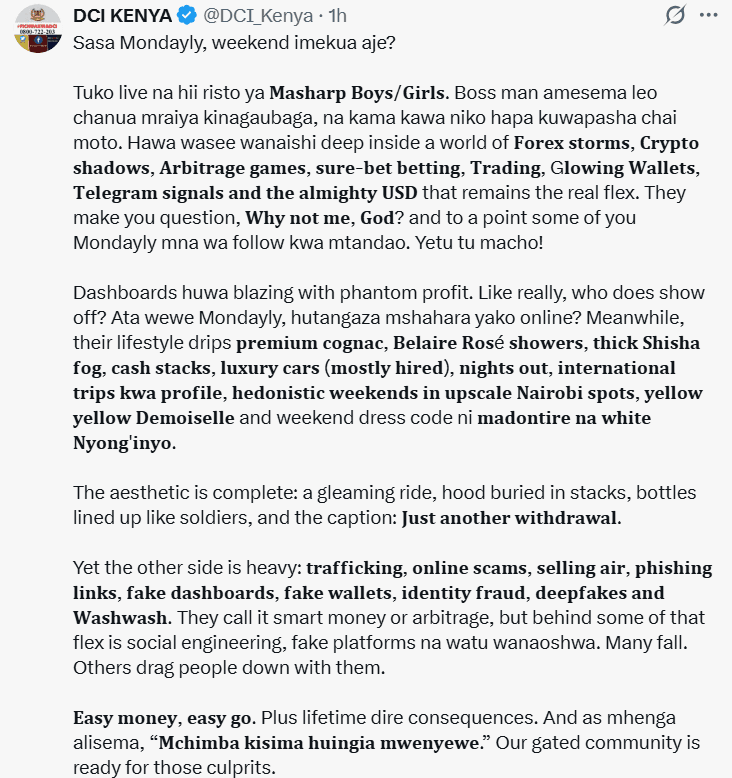
In its statement, the agency pointed to a digital scene built around forex trading, cryptocurrency, arbitrage, sure-bet betting, trading signals and Telegram groups. The US dollar is often used as the main status symbol. Coverage of the alert also refers to some of these actors as “Masharp” boys and girls, or “sharp boys.”
“Dashboards huwa blazing with phantom profit. Like really, who does show off?” the DCI asked, urging the public not to treat online wealth displays as proof of legitimate trading success.
How the Bait Works
According to the DCI, operators build an image of extreme success by posting stacks of cash, expensive drinks and high-end nightlife, luxury cars and international trips, and trading dashboards or digital wallets showing large, often simulated, dollar gains.
That image is then used to recruit followers into paid signals, mentorship programmes, group chats or investment platforms. The agency’s message is simple: the show is frequently stage-managed. It is not an audited record of regulated returns.
Many pitches arrive through Instagram, Telegram and similar channels. Victims are told they can copy trades, join a private “VIP” room, or deposit into a glowing wallet that later freezes when they try to withdraw.
What Investigators Say Is Behind the Flex
The DCI listed a darker side of the same online money culture. Methods and risks named in the warning include phishing links and fake trading platforms, counterfeit cryptocurrency wallets and fake dashboards, identity fraud, deepfakes and social engineering, and fraudulent investment schemes.
In its broader language, the agency also pointed to serious crimes that can sit around the same underworld, including trafficking. That is a warning about the wider ecosystem, not a claim that every flashy forex page is the same criminal file.
Victims can lose savings with little chance of recovery. People who recruit others into fraud also risk prosecution. “Easy money, easy go. Plus lifetime dire consequences,” the DCI said.
Mobile: Swipe left / right → ←
| Red flag | Why it matters |
|---|---|
| Guaranteed high daily or weekly returns | Legitimate markets do not promise fixed “easy” profits |
| Pay via personal M-Pesa or bank account | Regulated firms use official collection channels, not private numbers |
| Recruitment bonuses for bringing friends | Often a Ponzi-style growth model |
| Telegram or Instagram “signals only” groups | Hard to verify licensing or track funds |
| Screenshots of huge wallet balances | Easy to fake or edit |
| Pressure to deposit fast or “upgrade” to unlock withdrawals | Classic trap after first small “wins” |
← Swipe on mobile →
How to Protect Yourself
- Check licensing first. Before you send money for investments or collective schemes, verify the provider with the Capital Markets Authority (CMA). Use the CMA’s public notices and lists of licensed intermediaries and unlicensed entities.
- Ignore lifestyle as proof. Rented cars, nightclub photos and glowing dashboards are marketing, not audited accounts.
- Do not pay seed capital or “profits” into personal mobile numbers. Legitimate investment firms do not run client funds through private M-Pesa lines.
- Treat unsolicited mentorship pitches with suspicion. Be especially careful when someone demands registration fees, wallet top-ups or referral quotas.
- If you have already lost money, report promptly to the nearest DCI office. The CMA has also urged victims of unlicensed investment entities to cooperate with investigators.
In September 2026 the CMA separately cautioned the public against multiple unlicensed entities soliciting funds and said those names were under active investigation with the DCI. That notice is a different but related line of enforcement. Always check the current CMA list rather than relying on social media claims.
You can review the CMA’s public caution against investment scams on its website: cma.or.ke/public-caution-against-investment-scams.
What Is Legal and What Is Not
Not every conversation about forex or crypto is a crime. The DCI warning is aimed at fraud: fake platforms, unlicensed solicitation of the public, phishing and schemes that take money under false pretences.
Trading or investing only makes sense when the product, the intermediary and the risk disclosure are clear and, where required, licensed. Guaranteed returns, secret “arbitrage systems” and pressure to recruit your family are not normal features of regulated capital markets.
If a stranger online needs your money today to unlock tomorrow’s profit, step back. If the only “proof” is a screenshot and a rented Range Rover, step back further.
Read also:Is Cryptocurrency Banned in Kenya? Here Is What the Law Actually Says
Bottom Line
The DCI has told Kenyans not to trust flashy social media wealth as evidence of safe forex or crypto mentorship. The agency linked many of these personas to online fraud tools, from phantom dashboards and fake wallets to phishing and social engineering. Verify any investment offer through the CMA, avoid personal M-Pesa “investment” deposits, and report losses to the DCI. Easy money marketed online is often neither easy nor money you will see again.
Sources:
People Daily – DCI warns over forex and crypto scams (28 September 2026);
Kenyans.co.ke – DCI warns against online scams masquerading as investments;
The Kenya Times – DCI unmasks “sharp boys”;
Capital Markets Authority – Public caution against investment scams;
CMA homepage.
Report crime to the DCI. Confirm licensing on official CMA channels before you invest.