







Kenya’s manufacturing sector is moving in two directions at once. On one hand, fresh investment is flowing in, electric vehicle production is scaling up, and the government is announcing hundreds of millions of dollars in new industrial commitments. On the other, the Central Bank of Kenya has cut the sector’s growth forecast, energy costs are biting, and salt manufacturers are sounding the alarm over overlapping levies that threaten tens of thousands of jobs. Here is what is happening across the industry right now.
- CFAO Takes Near Full Control of Kenya Vehicle Manufacturers
- CBK Cuts Manufacturing Growth Forecast to 1.9%
- Salt Manufacturers Warn Over Overlapping Levies
- Electric Vehicle Production Is Gaining Real Momentum
- USD 600 Million in New Investments Announced at KIICO 2026
- KAM Leads Push to Lower Cost of Doing Business
The tensions playing out in Kenya’s manufacturing landscape are not unusual for an emerging industrial economy. Investment and structural challenges tend to arrive together, and how the sector navigates both will determine whether this period is remembered as a turning point or a missed opportunity.
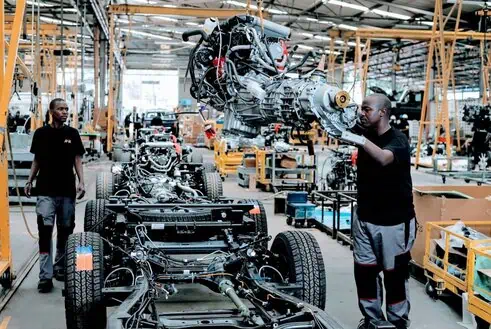
CFAO Takes Near Full Control of Kenya Vehicle Manufacturers
French mobility firm CFAO has injected KSh 2.4 billion into Kenya Vehicle Manufacturers, the Thika-based vehicle assembly plant, bringing its total ownership stake to 99.4 percent. The investment effectively wipes out the National Treasury’s remaining shareholding in the company, marking a full transition to private ownership under one of Africa’s largest automotive distribution groups.
The deal follows the recent launch of a dedicated Toyota Hiace assembly line at the Thika plant, also backed by CFAO Mobility Kenya. Together, these moves signal a long-term commercial commitment to local vehicle assembly that goes well beyond a passive equity stake. CFAO is building something in Thika, and the scale of the investment reflects confidence in Kenya as a regional automotive hub.
CBK Cuts Manufacturing Growth Forecast to 1.9%
The investment news arrives against a less comfortable macroeconomic backdrop. The Central Bank of Kenya has revised the manufacturing sector’s growth projection down to 1.9 percent, a significant cut from the earlier forecast of 3 percent. The downgrade reflects the combined pressure of rising energy costs, supply chain disruptions, and global inflationary pressures that continue to squeeze production margins across the industry.
For manufacturers already operating on tight margins, higher electricity costs are particularly damaging. Energy is one of the largest input costs in most production processes, and Kenya’s industrial electricity tariffs have been a persistent concern for the sector. Until that cost comes down or becomes more predictable, the ceiling on manufacturing growth remains lower than the sector’s potential suggests.
Salt Manufacturers Warn Over Overlapping Levies
One of the more urgent industry concerns coming to light involves Kenya’s salt manufacturing sector. Companies operating in the space have raised alarms about overlapping county and national levies that are pushing up the cost of doing business to unsustainable levels. The sector says up to 100,000 jobs are at risk if regulatory reforms are not introduced to rationalise the levy structure.
The salt industry is lobbying for tax write-offs on conservation spending and a clearer framework that eliminates duplication between national and county-level charges. The issue reflects a broader challenge in Kenya’s tax environment where devolution has sometimes created a layer of local levies on top of national ones, with manufacturers caught in between and unable to plan with any certainty.
Electric Vehicle Production Is Gaining Real Momentum
While some parts of the sector are under pressure, electric vehicle manufacturing is one of the clearer bright spots. EV assembler BasiGo has confirmed that over 100 electric buses and vans are already operational in Kenya, with production making heavy use of the Associated Vehicle Assemblers (AVA) facility in Mombasa. That number is small relative to Kenya’s total public transport fleet, but the direction of travel is clear.
Read also:Kenya Vehicle Manufacturers (KVM) — Vehicle Assembly & Body Building Thika | Business Listings Kenya
Local EV assembly reduces import costs, builds domestic technical capacity, and positions Kenya to benefit from the global shift toward electric mobility that is reshaping transport markets across the world. The AVA facility in Mombasa is emerging as a key anchor for this production, with capacity being expanded to meet growing order volumes.
USD 600 Million in New Investments Announced at KIICO 2026
President William Ruto used the KIICO 2026 forum to announce over USD 600 million in new manufacturing investments spanning fertilizer production, textiles, solar panel manufacturing, and plastics recycling. The commitments, made through Invest Kenya, signal continued appetite from both domestic and international investors for Kenya’s industrial sector despite the headwinds.
Fertilizer production investment is particularly significant given Kenya’s ongoing push to reduce dependence on imported inputs for agriculture. Solar panel manufacturing aligns with the country’s renewable energy ambitions and the global transition away from fossil fuels. Plastics recycling addresses both an environmental challenge and a growing demand for recycled raw materials in manufacturing supply chains.
KAM Leads Push to Lower Cost of Doing Business
The Kenya Association of Manufacturers is actively championing policies to reduce the cost of doing business, with a particular focus on strengthening local content requirements and expanding intra-African trade under the AfCFTA framework. KAM’s advocacy recognises that investment alone is not enough. The operating environment, from energy costs and tax structures to regulatory clarity and trade facilitation, has to support manufacturers in actually running profitable operations.
The association’s push for local content policies would benefit assemblers like KVM and EV producers like BasiGo by creating a clearer market preference for locally manufactured goods, both within Kenya and across the region. Whether those advocacy efforts translate into policy changes in the current budget cycle will be one of the key things to watch for the sector in the months ahead.