







Two banks essentially run Kenya’s financial sector right now. KCB Group and Equity Group Holdings sit firmly at the top, controlling the largest share of assets, deposits, and market value in the country.
Kenya’s banking industry remains heavily concentrated among five major players, often called the Big Five. Together, KCB, Equity, Co-operative Bank, NCBA, and Absa control the bulk of a record KSh 8.73 trillion total asset base.
Top Banks Ranked by Market Position
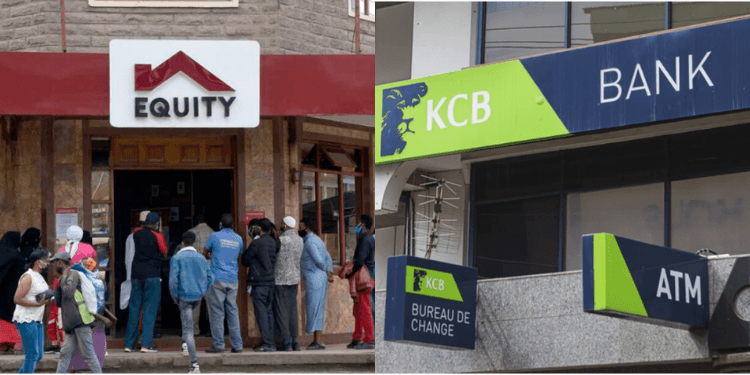
KCB Group holds the crown for the largest deposit pool in the country, with customer deposits reaching KSh 1.65 trillion as of Q1 2026. Its market share sits around 17 percent, and the bank now ranks as East Africa’s best-capitalised lender on the continent, with a market capitalisation of KSh 237.8 billion as of June 2026.
Equity Group Holdings takes the lead on valuation, commanding a market capitalisation of KSh 298.1 billion. The bank also holds the title of most profitable lender in East Africa, posting KSh 19.1 billion in profit after tax during Q1 2026 alone. Its total assets have crossed the KSh 2 trillion mark, cementing its position among the region’s financial heavyweights.
Co-operative Bank comes in third, deeply rooted in Kenya’s cooperative movement and SACCO network. The bank holds roughly 11.5 percent of the domestic market share, backed by a market capitalisation of KSh 203.9 billion and customer deposits exceeding KSh 500 billion.
Absa Bank Kenya maintains a solid Tier-1 position with a strong retail presence across the country. The bank currently sits at a market capitalisation of KSh 176.8 billion and is subject to an increased stake acquisition by its parent company, a development worth watching closely.
NCBA Bank Group rounds out the top five, dominating the digital banking and micro-lending space through mobile partnerships. With a market capitalisation of KSh 150.4 billion, NCBA remains a key focal point for regional expansion discussions.
What’s Driving These Numbers
KCB and Equity continue their tug of war at the top, but each dominates a different metric. KCB holds the deposit crown, while Equity commands the highest investor valuation on the Nairobi Securities Exchange.
Digital banking has fundamentally changed how these institutions operate too. Major Tier-1 lenders like KCB now report that over 99 percent of transactions happen outside physical branches, moving through mobile apps, agent banking, and other digital channels instead.
Interest rates have also played a role in shaping the sector’s performance. The Central Bank of Kenya lowered its benchmark lending rate to 8.75 percent, a move that helped stimulate credit recovery across the industry. This contributed to a record combined sector profit before tax of KSh 83.5 billion in Q1 2026.
Why This Concentration Matters
Having five banks control such a large share of the market says a lot about how Kenya’s financial sector has consolidated over the years. Smaller banks increasingly struggle to compete on capital strength and digital infrastructure against these established giants.
For customers, this concentration often means more resources poured into digital banking tools and broader branch or agent networks. It also raises ongoing questions about competition and pricing power within the sector.
Read also:Top PSV Insurers in Kenya by Market Share 2026
Frequently Asked Questions
Which bank has the largest market share in Kenya?
KCB Group holds the largest market share at approximately 17 percent, driven by its position as the top bank by customer deposits.
Which bank is the most profitable in Kenya?
Equity Group Holdings is the most profitable bank in East Africa, posting KSh 19.1 billion in profit after tax during Q1 2026.
What are the Big Five banks in Kenya?
The Big Five are KCB Group, Equity Group Holdings, Co-operative Bank, Absa Bank Kenya, and NCBA Bank Group.
How much of banking transactions happen outside branches in Kenya?
Major lenders like KCB report that over 99 percent of transactions now occur through digital channels and agent banking rather than physical branches.
What is Kenya’s current benchmark lending rate?
The Central Bank of Kenya has set the benchmark lending rate at 8.75 percent, supporting credit recovery across the sector.
Kenya’s banking sector in 2026 is clearly a story of consolidation, with KCB and Equity leading a small group of dominant players. Strong digital adoption and easing interest rates have combined to push profits to record levels across the industry.
With such concentrated market power at the top, how the Big Five continue to compete and innovate will likely shape the direction of Kenyan banking for years to come.