







Family Bank’s profit after tax climbed 61.8 percent to KSh 3.70 billion in the six months to June 30, 2026, up from approximately KSh 2.28 billion a year earlier.
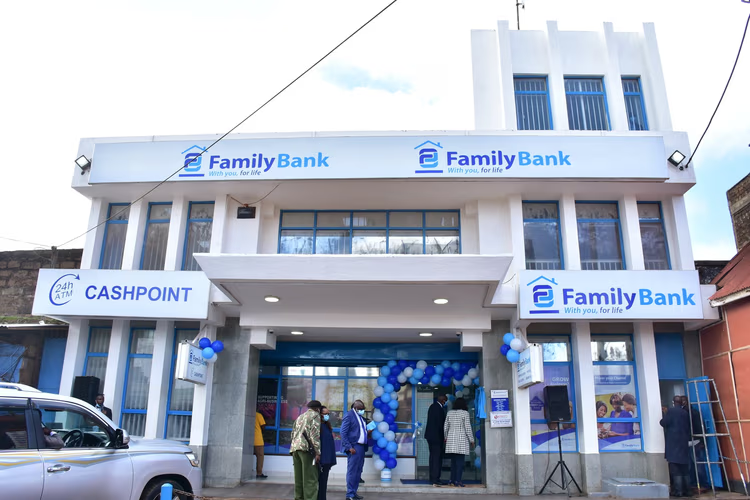
The result extends the lender’s profit-growth streak to eight straight years. Stronger lending activity, together with higher interest income, provided the main lift.
The earnings report comes less than two months after Family Bank joined the Nairobi Securities Exchange (NSE), giving existing shareholders a formal market for trading their stock.
Family Bank Earnings Improve
Profit before tax rose 59.3 percent to KSh 4.67 billion, while net interest income increased 40.7 percent to KSh 9.79 billion.
Net interest income is the money a bank keeps after collecting interest from borrowers and paying interest to depositors and other funders. When it grows faster than costs, it can give profits a substantial boost.
| Financial metric | H1 2025 | H1 2026 | Change |
|---|---|---|---|
| Profit after tax | Approximately KSh 2.28 billion | KSh 3.70 billion | 61.8% increase |
| Profit before tax | Not stated | KSh 4.67 billion | 59.3% increase |
| Net interest income | KSh 6.95 billion | KSh 9.79 billion | 40.7% increase |
| Total operating income | Not stated | KSh 12.09 billion | 25.5% increase |
| Customer deposits | Not stated | KSh 180.20 billion | 20.0% increase |
| Total assets | Not stated | KSh 238.90 billion | 24.0% increase |
| Gross non-performing loans | KSh 15.22 billion | KSh 18.14 billion | 19.2% increase |
Lending Fuels Growth
Lending was at the heart of the performance. Net interest income made up 81 percent of total operating income in the first half of 2026, compared with 64 percent in 2017.
That change shows how much more important lending has become to Family Bank’s business. The bank earns interest from loans, then pays part of its income to depositors and other sources of funding.
Family Bank allocated KSh 35.6 billion to retail and micro, small, and medium-sized enterprise customers. Commercial enterprise accounts received another KSh 15.2 billion.
Those figures point to a strong focus on households, entrepreneurs, and established businesses. Customers in these segments often need money for working capital, stock purchases, expansion, trade, and personal expenses.
Chief Executive Officer Nancy Njau has linked the bank’s growth to its support for retail and business customers. The strategy has helped Family Bank expand its lending base while building stronger interest income.
Deposits and Assets Grow
Customer deposits rose 20 percent to KSh 180.20 billion. That gives the bank more money to lend and invest, although attracting deposits can become costly when competition for customers intensifies.
Total assets grew 24 percent to KSh 238.90 billion. The figure covers the bank’s loans, investments, cash, property, and other resources.
For Family Bank, the next question is whether this larger balance sheet can continue producing strong returns without creating too much credit risk. Growth looks good on paper, but the loans behind it still have to perform.
Shares Gain After NSE Listing
Family Bank listed 1,662,654,760 ordinary shares by introduction on the NSE on June 23, 2026. The shares entered the market at an introductory price of KSh 18 each.
The details appear in Family Bank’s official 2026 information memorandum.
A listing by introduction places existing shares on the exchange without a conventional public offer of new shares. It gives shareholders a platform to trade their holdings and gives investors a market-based way to value the bank.
Family Bank shares closed at KSh 32.95 on August 17, 2026, after trading in the low-to-mid KSh 30 range. The closing price puts the bank’s market capitalisation at roughly KSh 54 billion to KSh 55 billion.
The stock remains well above its KSh 18 introduction price. That rise has increased the paper value of existing holdings, although an investor’s actual return depends on the purchase price, transaction costs, taxes, and whether the shares have been sold.
Bad Loans Remain a Concern
Family Bank’s strong profit growth came alongside a rise in gross non-performing loans. NPLs increased 19.2 percent to KSh 18.14 billion from KSh 15.22 billion.
The NPL ratio remained elevated in the mid-teens. Reports have placed it at 14.9 percent, compared with 13.7 percent previously, although the exact calculation should be checked against the full unaudited statements.
Non-performing loans are loans whose repayments are seriously overdue or appear unlikely to be recovered in full. When they rise, banks usually set aside more money to absorb possible losses.
Management cited higher provisions as part of its response to the pressure on the loan book. Those provisions may weigh on short-term earnings, but they give the bank a larger cushion if some borrowers fail to repay.
The real test will be whether the increase in bad loans slows in the second half of the year. Recovery efforts, loan screening, and the quality of new lending will all matter.
Growth Comes with Risks
Family Bank’s results show a lender growing quickly across earnings, deposits, assets, and lending. That momentum gives the bank room to expand, but it also raises the stakes if economic conditions weaken.
Retail customers, small businesses, and commercial borrowers can all feel the effects of higher costs, weaker demand, or changing interest rates. A slowdown in their cash flow can quickly affect loan repayments.
Family Bank will need to keep a close eye on its borrowers while maintaining enough capital and provisions to manage possible losses. The bank’s future results will depend not only on how much it lends, but also on how well those loans perform.
Related:Family Bank Kenya — Retail, SME & Corporate Banking, 90+ Branches
What Investors Should Watch
Investors will be looking for continued growth in net interest income, stable deposit funding, and better control of non-performing loans. Operating costs, liquidity, capital levels, and loan recoveries will also shape the bank’s next results.
The NSE performance will remain another point of interest after the strong move from the KSh 18 introduction price. A higher share price can improve visibility, but market value alone does not replace strong earnings and sound asset quality.
Family Bank’s official results are available through its financial-results page. Investors can also consult the Nairobi Securities Exchange for listing and market information, and the Central Bank of Kenya for banking-sector regulatory information.
Editorial Status
Family Bank’s H1 2026 profit, net interest income, balance-sheet figures, and gross NPLs are confirmed by the bank’s results announcement and contemporaneous reports published on August 18, 2026. The listing details come from the official information memorandum, while the share-price figure reflects the August 17 close.
The exact NPL-ratio methodology and any direct management quotations should still be cross-checked against the full unaudited statements before publication.