






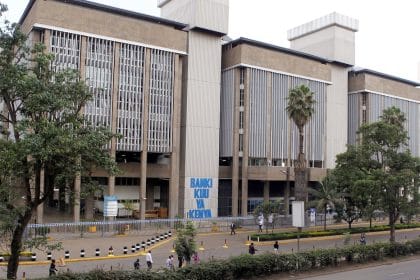

Standard Chartered Bank Kenya has exited the Central Bank of Kenya’s large-bank peer group after its weighted market-size index fell to 4.5 percent in 2025, below the 5 percent cut-off for Tier I status.
The shift is recorded in the CBK Bank Supervision Annual Report 2025. Kenya’s large peer group shrinks from nine banks to eight. StanChart now ranks ninth overall and heads the medium (Tier II) group on the composite index.
This is a relative market-size reclassification, not a capital-adequacy failure. Large banks are those with a composite index of 5 percent or more; medium banks sit between 1 percent and under 5 percent; small banks are under 1 percent.
How StanChart Slipped Below 5%
StanChart’s index dropped to 4.5 percent in December 2025 from 5.4 percent in 2024, according to coverage of the same CBK tables.
On the audited December 2025 market-share appendix, Standard Chartered Bank (K) Ltd shows:
- Market-size index: 4.5% (rank 9)
- Total net assets: about KSh 364.5 billion (4.4% of the market)
- Total deposits: about KSh 284.7 billion (4.5%)
CBK explicitly attributes the large peer group’s smaller combined share to StanChart’s move from large to medium. Large banks’ combined market share fell to 69.7 percent from 75.6 percent; the medium group rose to 23.2 percent from 16.7 percent after StanChart entered and Sidian Bank also moved up from the small group.
The bank remains well capitalised on regulatory ratios in its own reporting. The peer-group change tracks balance-sheet weight relative to faster-growing local rivals, not a CBK finding that StanChart is undercapitalised.
StanChart’s 2025 results were also affected by one-off costs, including a past-service pension charge after a Supreme Court–related ruling (the bank’s annual report cited a one-off past service cost in the billions of shillings). Treat pension figures from secondary summaries carefully and use the bank’s published accounts for exact amounts.
KCB Cements the Top Spot
KCB Bank Kenya Limited remains number one. Its market-size index rose to 17.3 percent from 16.6 percent, with net assets of about KSh 1.50 trillion and deposits of about KSh 1.15 trillion.
Equity Bank Kenya Ltd is second at 11.8 percent (net assets about KSh 1.04 trillion; deposits about KSh 849 billion). The gap between KCB and Equity is about 5.5 percentage points on the 2025 index. Industry commentary notes that gap is much wider than in 2021, when the two were separated by only about a quarter of a point.
Co-operative Bank of Kenya is third at 9.4 percent, followed by NCBA at 7.9 percent.
Kenya’s Large Banks After the Reclassification
Mobile: Swipe left / right to see all columns → ←
| Rank | Bank | Market-size index | Peer group |
|---|---|---|---|
| 1 | KCB Bank Kenya | 17.3% | Large (Tier I) |
| 2 | Equity Bank Kenya | 11.8% | Large |
| 3 | Co-operative Bank | 9.4% | Large |
| 4 | NCBA Bank Kenya | 7.9% | Large |
| 5 | Absa Bank Kenya | 6.4% | Large |
| 6 | Stanbic Bank Kenya | 5.8% | Large |
| 7 | I&M Bank | 5.6% | Large |
| 8 | Diamond Trust Bank (DTB) | 5.6% | Large |
| 9 | Standard Chartered Kenya | 4.5% | Medium (Tier II) |
| 10 | Prime Bank | 4.3% | Medium |
← Swipe on mobile → Source: CBK Bank Supervision Annual Report 2025, market share as at December 2025
I&M and DTB both sit at 5.6 percent, just above the large-bank line. Prime Bank at 4.3 percent is the closest medium-bank challenger to the 5 percent threshold after StanChart.
What the Index Measures
CBK’s composite market-size index weights:
- net assets;
- customer deposits;
- capital and reserves;
- number of deposit accounts;
- number of loan accounts.
It is not the same as pure asset rank or pure deposit rank. A bank can look large on one line and still sit lower on the blended index. Peer groups are for supervisory comparison; they are not a profitability league table.
What It Means for Customers and the Market
For customers, StanChart’s products, licences and brand do not vanish because of a peer-group label. The bank remains a major international franchise in Kenya.
For the industry, the story is concentration and catch-up. Local giants KCB, Equity and Co-op continue to set the scale, while StanChart’s relative share has slipped as others grew faster. Medium-bank names such as Prime Bank show how close the next rung is to the 5 percent line.
Large banks still hold about seven-tenths of the composite market; medium banks now hold a bigger slice than a year earlier mainly because StanChart joined them.
Read also:CBK: Seven Banks Missed Sh3bn Core Capital Rule in 2025
Bottom Line
Standard Chartered Kenya is a Tier II (medium) bank on CBK’s 2025 classification after its market-size index fell to 4.5 percent. Eight banks remain in the large peer group, led by KCB at 17.3 percent, with Equity second at 11.8 percent and a much wider gap than in the early 2020s.
The demotion is about relative market weight, not a CBK finding that StanChart failed capital rules. Watch next year’s appendix: reclaiming 5 percent would put the lender back among the large banks; Prime Bank and others will try to cross that line from below.
Sources:
CBK – Bank Supervision Annual Report 2025 (PDF, Appendix IV market share);
Tuko – CBK lists 8 biggest banks as StanChart drops from Tier One (22 September 2026);
The Kenya Times – Top banks by market share (CBK 2025 data).