






BOC Kenya Plc recorded a 39.8 percent decline in profit after tax to KSh 100.4 million for the six months ended 30 June 2026, down from KSh 166.7 million a year earlier. The industrial and medical gases manufacturer saw revenue fall 17.2 percent to KSh 600 million as large one-off customer engineering projects that powered its strong 2025 performance did not recur. Higher distribution, selling and administrative costs added further pressure.
Despite the softer earnings, the company strengthened its balance sheet significantly. Cash and cash equivalents rose 49.9 percent to KSh 1.29 billion. Net cash from operations climbed 40.3 percent to KSh 236.3 million. On the back of this liquidity, the board declared a 60 percent higher interim dividend of KSh 4.00 per share, up from KSh 2.50 in the previous corresponding period. The results were announced via the Nairobi Securities Exchange on 21 August 2026.
Key Financial Highlights: H1 2026 vs H1 2025
| Metric | H1 2026 (KSh) | H1 2025 (KSh) | Change |
|---|---|---|---|
| Revenue | 600.0 million | 724.9 million | -17.2% |
| Gross Profit | 330.5 million | 392.4 million | -15.8% |
| Gross Margin | 55.1% | 54.1% | +1.0 pp |
| Overheads / Expenses | 190.8 million | 162.7 million | +17.3% |
| Profit Before Tax | 157.6 million | 251.6 million | -37.4% |
| Profit After Tax | 100.4 million | 166.7 million | -39.8% |
| Earnings Per Share | 5.14 | 8.54 | -39.8% |
| Net Cash from Operations | 236.3 million | 168.5 million | +40.3% |
| Cash & Cash Equivalents | 1.29 billion | 863 million | +49.9% |
| Interim Dividend per Share | 4.00 | 2.50 | +60.0% |
Total assets also expanded, reaching approximately KSh 2.7 billion, an increase of about 11.7 percent. Detailed figures are consistent across reports from Kenyan Wall Street and Mwango Capital.
What Drove the Decline in Earnings
The main reason for the revenue drop was the absence of large customer engineering projects that boosted results in the first half of 2025. Those one-off contracts had helped BOC Kenya post record first-half numbers last year, including a 170 percent jump in profit after tax.
At the same time, distribution, selling and administrative expenses rose 17.3 percent to KSh 190.8 million. Management pointed to inflationary pressures in Kenya together with higher fuel and energy costs as the key drivers, according to the management commentary released alongside the results.
Even with the cost increase, the company managed a slight improvement in gross margin to 55.1 percent from 54.1 percent. This shows that the core gases business continued to generate healthy unit economics despite softer top-line volumes.
The 2026 first-half performance ends a five-year run of consecutive first-half profit growth. Still, the KSh 100.4 million profit remains well above the levels recorded between 2017 and 2024.
Strong Cash Generation and Higher Dividend
While profit fell, cash generation moved in the opposite direction. Net cash from operations rose 40.3 percent to KSh 236.3 million. Closing cash and cash equivalents jumped nearly 50 percent to KSh 1.29 billion.
This liquidity strength gave the board confidence to raise the interim dividend by 60 percent to KSh 4.00 per share. Book closure is set for 21 September 2026, with payment expected around 19 October 2026.
BOC Kenya has a long track record of consistent shareholder returns. In the full year 2025 the company paid a total dividend of KSh 12.85 per share (interim KSh 2.50 plus final KSh 10.35), the highest in its recent history, after posting full-year profit after tax of KSh 314 million (see the audited FY 2025 results PDF).
Company Background and Strategic Pivot
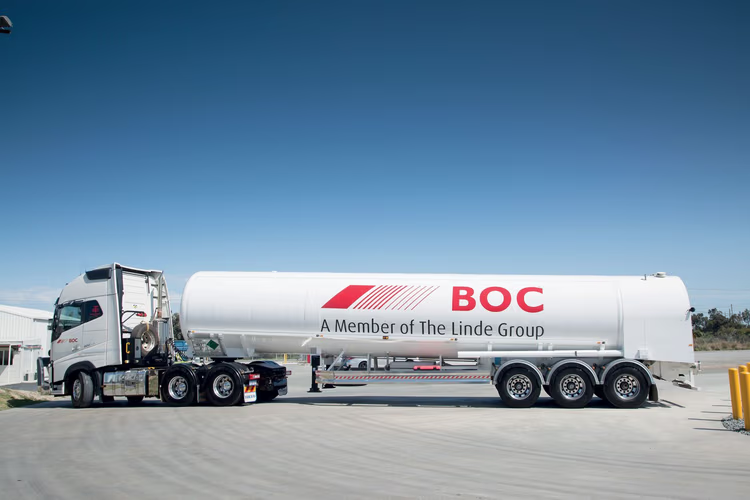
BOC Kenya Plc is a leading manufacturer and supplier of industrial, medical and specialty gases in East Africa. The company was established in Mombasa in 1940, began operations in Nairobi in 1947, and listed on the Nairobi Securities Exchange in 1969. It is majority-owned (approximately 65 percent) by BOC Holdings (UK), which is part of the global Linde Group, the world’s largest industrial gases company. More details are available on the official company website at boc.co.ke.
Its products serve critical sectors including healthcare (medical oxygen and related gases for hospitals), manufacturing, food processing, agriculture, fabrication, energy and research. The company also provides customer engineering services such as gas pipelines, storage facilities and LPG installations.
Management has been deliberately shifting focus toward more predictable, recurring demand in its core areas of medical gases, agriculture, fabrication and manufacturing. This pivot started more slowly than expected in early 2026 but is now gathering momentum heading into the second half of the year. The goal is to reduce reliance on large, one-off engineering contracts and build steadier revenue streams.
Lawrence Githinji serves as Managing Director, having been appointed to the board in March 2025. Teddy Mutinda is Finance Director.
Read also:Family Bank Profit Jumps 61.8% to KSh 3.70 Billion
—Equity Group H1 Profit Jumps 32% to Sh45.5bn, Skips Interim Dividend Again
Outlook for the Rest of 2026
Management expects the accelerated focus on core gas demand to support revenue recovery and improve earnings quality in the second half. Higher fuel and energy costs remain a headwind, but the strong cash position provides a solid buffer for operations and continued shareholder distributions.
For investors, the combination of a healthy cash balance, improved gross margins and a generous interim dividend offers reassurance even after a softer first half. The long-term fundamentals of medical and industrial gas demand in Kenya remain supportive, particularly as the health sector expands and manufacturing activity recovers.
BOC Kenya continues to play a quiet but essential role in Kenya’s economy, supplying life-saving medical oxygen and the industrial gases that keep factories and farms running. The first-half numbers show the impact of project timing and cost pressures, but the underlying balance sheet and dividend policy remain robust.
Independent coverage of the results also appeared on Business Today.
Sources
- NSE PLC official announcement of BOC Kenya Plc Unaudited Group Results for the 6 Month Period Ended 30 June 2026 (21 August 2026)
- Kenyan Wall Street – BOC Kenya H1 2026 results summary (20 August 2026)
- Mwango Capital – Full H1 2026 financials and YoY comparisons (21 August 2026)
- Mwango Capital – BOC Kenya H1 2026 management commentary (21 August 2026)
- Business Today – BOC Kenya H1 Net Earnings drop to KSh 100.4m (21 August 2026)
- BOC Kenya Plc Audited Group Results for the Year Ended 31 December 2025 (PDF)
- BOC Kenya official website
All figures cross-checked against the primary NSE release and multiple independent market reports published on 20–21 August 2026. No facts invented.