

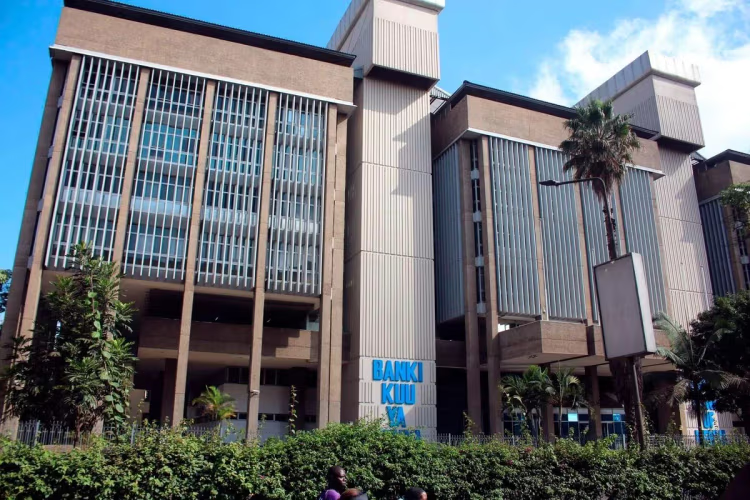
Kenyan investors submitted bids worth Sh460.4 billion against the Central Bank’s Sh150 billion target for its latest infrastructure bond reopening, an oversubscription of Sh310.4 billion. CBK accepted Sh312.0 billion of that demand, more than double what it originally set out to raise.
The sale involved the reopening of three infrastructure bonds, IFB1/2019/016, IFB1/2021/018, and IFB1/2021/021, each carrying different remaining tenors and appealing to different segments of the investor base, from banks seeking shorter duration to pension funds locking in returns over the long term.
How Each Tranche Performed
The three reopened bonds carried different maturities and accepted yields, giving investors a spread of options across the yield curve. Here’s how the auction broke down by tranche:
| Bond | Remaining Tenor | Amount Accepted | Weighted Average Yield |
|---|---|---|---|
| IFB1/2019/016 | 9.3 years | Sh112.6 billion | 12.20% |
| IFB1/2021/018 | 12.7 years | Sh105.5 billion | 12.69% |
| IFB1/2021/021 | 16.2 years | Sh93.9 billion | 13.05% |
Notably, yields rose modestly with tenor, the shortest bond settled just above 12 percent, while the longest 16-year paper cleared just above 13 percent, a fairly typical upward slope reflecting the extra compensation investors demand for locking capital away longer.
Why the Government Is Leaning So Hard on These Bonds
According to Business Daily, the Sh150 billion target on this reopening is part of a much larger financing push. The Central Bank of Kenya is working to fill the government’s domestic borrowing target of Sh987.4 billion for the 2026/2027 financial year, with heavy interest payments straining public coffers and forcing delayed disbursements to counties and contractors.
To ease pressure from maturing short-term debt, CBK has also opened a switch bond facility, letting investors convert maturing Treasury bills and older bonds directly into longer-term securities rather than facing a wall of repayments all at once.
Part of a Broader Pattern of Strong Demand
This auction fits a pattern that’s held through much of the 2026/27 financial year so far. The first auction of the year, a triple-tranche reopening of 10, 20, and 30-year bonds, drew Sh144.47 billion in bids against a Sh70 billion offer, a 206.38 percent subscription rate. A July auction targeting Sh40 billion pulled in Sh85.9 billion, a 214.82 percent oversubscription rate.
Zooming out further, the previous financial year’s bond programme, FY2025/26, raised Sh1.006 trillion in net proceeds across 19 auctions and two tap sales, the largest annual bond issuance total on record for Kenya at the time. This latest sale is one strong result within a broader run of heavy demand, not a record-setter on its own.
What’s Driving the Demand
Three factors explain why investors keep showing up in force. Infrastructure bonds carry a full exemption from withholding tax in Kenya, making their net yield meaningfully higher than a comparable standard fixed-coupon bond offering a similar headline rate.
Institutional investors, particularly pension funds and insurance companies, are also positioning to lock in current double-digit yields ahead of any future decline in the Central Bank Rate. Analysts at Standard Investment Bank have pointed to inflationary pressures and continued government borrowing needs as reasons to expect strong demand persisting through the rest of the year. Ample liquidity within the domestic banking sector rounds out the picture, giving investors a low-risk, tax-free destination for capital that would otherwise sit idle.
Related:CBK Infrastructure Bonds: What Kenyan Investors Should Know
How to Buy an Infrastructure Bond
Participating in future CBK bond auctions runs through DhowCSD, the Central Bank’s Central Securities Depository platform. Here’s what the process looks like:
| Step | What You Need |
|---|---|
| 1. Register | Sign up via the official CBK portal or the DhowCSD mobile app |
| 2. Documents | KRA PIN, National ID or passport copy, bank account details |
| 3. Minimum bid | Sh50,000 under the current prospectus for non-competitive bids |
| 4. Bidding method | Non-Competitive Bidding for amounts under Sh50.0 million |
Under Non-Competitive Bidding, your bid is automatically accepted at the market-determined weighted average interest rate, meaning you don’t need to guess at a specific yield, you simply receive whatever rate the auction settles at. Note that earlier infrastructure bond prospectuses have sometimes set the minimum at Sh100,000, so always confirm the exact threshold on the specific prospectus for the bond you’re bidding on.
What to Know Before You Bid
Infrastructure bonds carry long tenors, often well over a decade, meaning your capital stays locked in for years unless you sell on the secondary market. Given how consistently oversubscribed recent auctions have been, get your DhowCSD account set up and funded ahead of the actual auction date, CBK has closed bidding early on several occasions this year when demand ran this high.