









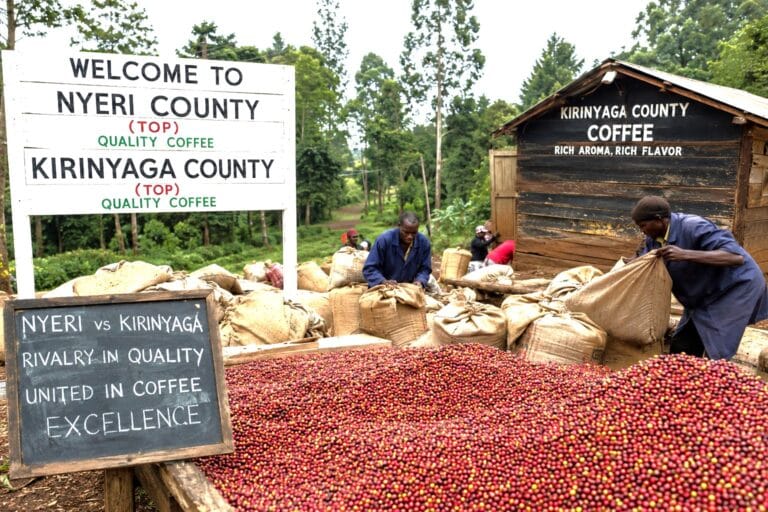
Kirinyaga is home to 14 Farmers Cooperative Societies operating through 74 coffee factories spread across the county. That density of organised farming infrastructure is not common in Kenya’s coffee belt, and it gives Kirinyaga growers access to a level of processing capacity and market organisation that smaller, more fragmented regions simply cannot replicate.
A Farmer-Owned System That Controls Its Own Chain
At the centre of all this sits Kirinyaga Union, a farmer-owned institution that has grown well beyond what most people imagine when they think of a traditional cooperative union. It now runs a modern coffee mill, a licensed brokerage firm, and a direct-sales marketing agency. That combination is significant because it means Kirinyaga farmers are not dependent on outside brokers or processors to get their coffee to market. They handle the milling, manage the brokerage, and pursue direct sales to premium buyers themselves.
Keeping that value inside the farmer-owned system means more of the final sale price finds its way back to the grower. It also gives the union leverage in international market negotiations that a simple producer cooperative would not have.
Production Numbers That Tell the Story
The growth in cherry production over the past three seasons makes the case clearly. In 2023/24, Kirinyaga farmers delivered 42.3 million kilograms of cherry. The following season, that climbed to 45.7 million kilograms. In the current 2025/26 season, the figure stands at 49.1 million kilograms and is still being counted.
That is an increase of nearly 7 million kilograms in three years, achieved at a time when many other coffee-growing regions across Kenya are reporting flat or declining output. Soil quality and rainfall play a role, as does the county’s proximity to Mount Kenya, but production does not grow consistently like this without deliberate effort at the cooperative level.
Individual Cooperatives Operating at Scale
Several of Kirinyaga’s cooperatives have grown large enough that they individually outproduce entire coffee-growing counties elsewhere in Kenya. Baragwi Farmers Cooperative Society, the county’s largest, is projected to deliver more than 13 million kilograms of cherry in the current season alone. Inoi FCS is on course to exceed 2.2 million kilograms.
Other major contributors including Rung’eto, Kabare, Mutira, Mwirua, Kibirigwi, and Karithathi continue to post strong seasonal volumes year after year. That consistency across multiple cooperatives, rather than relying on a single standout performer, is what makes Kirinyaga’s model genuinely robust.
Farmer Payments Among the Best in the Country
Production volumes matter, but what farmers ultimately care about is what lands in their accounts at the end of the season. On that measure, Kirinyaga cooperatives have consistently placed among the highest-paying societies in Kenya. Strong management, high coffee quality, and effective market access have combined to ensure that the county’s output commands good prices, and that those prices are passed through to growers rather than absorbed by inefficiencies along the way.
Payment rates vary between cooperatives within the county, and no system is perfect. But Kirinyaga has repeatedly demonstrated that a well-run cooperative focused on quality and marketing can deliver meaningfully better incomes to its members than the national average.
Governance as the Real Competitive Advantage
Perhaps the most underappreciated part of the Kirinyaga story is how the county has handled the inevitable internal pressures that come with running large farmer institutions. Cooperative disputes, leadership contests, and governance challenges are not unique to Kirinyaga. They happen everywhere coffee is grown and organised collectively.
What sets Kirinyaga apart is what happens next. In many other regions, disagreements lead to splits, the formation of breakaway societies, and the fragmentation of scale that took years to build. Kirinyaga has generally managed to work through its conflicts while keeping its institutions intact. The focus has stayed on improving performance rather than creating new organisations to replace troubled ones. That discipline has preserved the scale and negotiating power that make the county’s model work.
A Blueprint Worth Studying
As Kenya’s Ministry of Agriculture works toward increasing national coffee production and improving what farmers earn, Kirinyaga offers a practical and tested blueprint. Strong cooperatives with proper governance, farmer-owned institutions that control the value chain, investment in processing and marketing, and a cultural commitment to staying united around shared goals those are the ingredients.
None of them are secrets. None of them require extraordinary resources that other counties do not have access to. What they require is sustained commitment from farmer leaders and members who understand that the cooperative is more valuable intact than divided.
Kirinyaga is no longer just a leading coffee county. It has become the benchmark against which Kenya’s cooperative coffee model is measured, and the standard it has set is one that the rest of the sector would do well to study carefully.
In the next article, we examine how individual Kirinyaga cooperatives performed on farmer payments and identify which societies delivered the highest returns to their growers this season.