










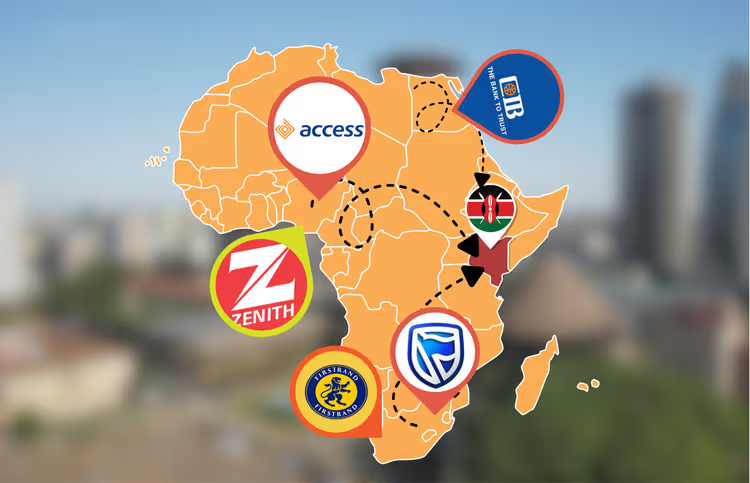
Kenya has become Africa’s most contested banking battleground. South African and Nigerian banking giants are deploying billions of dollars to acquire Kenyan lenders, and the trigger behind this acquisition wave is a regulatory change that is forcing smaller banks to either find capital fast or sell out entirely.
The scale of activity right now is unlike anything Kenya’s banking sector has seen before. Multiple billion-dollar deals are unfolding simultaneously, and understanding why requires looking at one specific piece of legislation that changed everything.

The Capital Rule Forcing This Consolidation
Kenya’s Business Laws Amendment Act raises minimum core capital requirements for commercial banks from KSh 1 billion to KSh 10 billion by 2029. An interim deadline of KSh 5 billion looms in December 2026, and roughly a third of Kenya’s smaller lenders are facing capital gaps they cannot close on their own.
That gap is exactly what foreign banking giants have been waiting for. Banks that cannot raise capital fast enough become acquisition targets, and deep-pocketed regional players are stepping in before the deadline forces distressed sales at worse terms.
South African Banks Are Leading the Charge
South Africa’s mature domestic banking market is growing slowly, pushing its biggest lenders to chase higher growth corridors elsewhere on the continent. Kenya has become the primary destination for that capital.
Absa Group launched a $238 million tender offer to raise its Absa Bank Kenya stake to 85 percent. Nedbank Group shook the market with an $856 million bid for a controlling 66 percent stake in NCBA Group, delivering massive payouts to some of Kenya’s most prominent business families in the process.
Standard Bank Group, Africa’s largest lender by assets, has stated explicitly that it wants to become Kenya’s largest bank by 2030. It is backing that ambition with acquisitions and a $45 billion regional infrastructure financing pipeline.
Nigerian Banks Are Fighting for Their Own Foothold
Nigerian banking giants are not standing by while South African rivals expand. They are using Nairobi as their launchpad into East and Central Africa, building pan-African networks that need a strong Kenyan presence to function.
Read also:Absa Group Bids KES 30.9 Billion to Raise Kenya Stake to 85%
Zenith Bank completed a full acquisition of Kenya’s Paramount Bank, marking its first direct operational footprint in East Africa. Access Holdings has secured regulatory approval to acquire the National Bank of Kenya, continuing its aggressive regional expansion strategy across the continent.
Why Everyone Wants a Piece of Kenya
Kenya sits at the centre of the East African Community, linking trade corridors across Uganda, Tanzania, Rwanda, and the DRC. For any bank with regional ambitions, a strong Kenyan base is close to non-negotiable.
Kenya’s mobile money adoption rates rank among the highest in the world, making it the ideal testing ground for banks building digital-first portfolios. That digital infrastructure gives acquiring banks a faster path to scale than building similar capability from scratch elsewhere.
Western Banks Are Leaving as African Giants Move In
Part of what is creating room for this expansion is a parallel retreat by Western banking groups. Standard Chartered, BNP Paribas, and Société Générale have all been trimming their African footprints in recent years, scaling back operations that no longer fit their global strategic priorities.
That retreat has created a structural void, and regional financial powerhouses from South Africa and Nigeria are filling it with speed and capital that Western banks are no longer willing to commit. The result is a historic realignment of financial power across the continent.
What This Means for Kenyan Banking Customers
For ordinary Kenyans, this wave of acquisitions could bring real benefits over time. Larger, better-capitalised parent companies typically mean stronger balance sheets, more competitive lending rates, and greater investment in digital banking infrastructure.
The flip side is consolidation risk. As more Kenyan banks come under foreign ownership, questions about local decision-making autonomy and whether smaller customers remain a priority for institutions now answering to shareholders in Johannesburg or Lagos will be worth watching closely as this consolidation wave plays out over the coming years.