








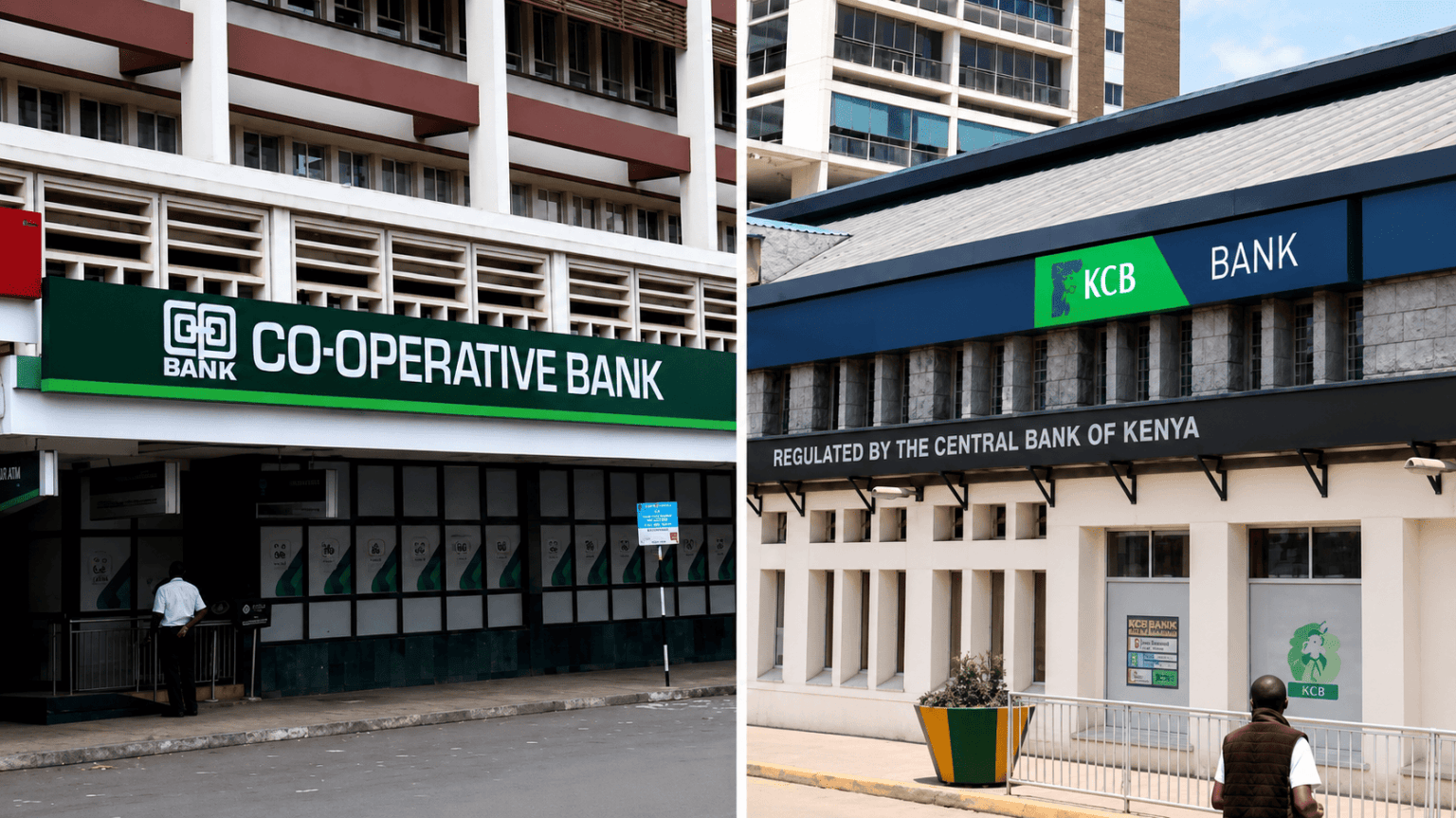
KCB Group has reclaimed its position as Kenya’s most profitable bank, posting a half-year profit before tax of Sh49.3 billion, well ahead of Co-operative Bank’s Sh23.1 billion. Both lenders released their H1 2026 results this week, and both delivered genuinely strong numbers, but KCB’s scale advantage put clear daylight between the two.
What makes Co-op Bank’s result notable despite finishing second is that Sh23.1 billion represents the bank’s best-ever half-year performance in its history. Two of Kenya’s biggest banks just had standout six months, and the details behind each set of results tell slightly different growth stories.

KCB’s Numbers: Bigger, Broader, and Still Growing
KCB Group’s profit before tax climbed 20.8 percent to Sh49.3 billion for the six months to June 2026, up from Sh40.8 billion a year earlier. Profit after tax rose 14 percent to Sh36.87 billion, a record first-half figure for the group, driven by total income growing 9.5 percent to Sh108.1 billion.
KCB Group CEO Paul Russo credited the diversified business model behind the result. “Our strong half-year performance reflects the resilience of KCB Group’s diversified business model, the strength of our regional footprint, and the confidence our customers continue to place in us,” he said, adding that the group remained focused on digital transformation and long-term value creation for shareholders.
The balance sheet expanded 16.8 percent to Sh2.3 trillion, powered by a 15.1 percent rise in customer deposits to Sh1.7 trillion and 14.2 percent growth in gross loans to Sh1.3 trillion. Regional operations outside Kenya contributed Sh15 billion in profit before tax, up 10 percent, with Tanzania, Uganda, and South Sudan all playing a role. The board has recommended a Sh9.64 billion interim dividend payout to shareholders.
Co-op Bank: A Record Result Built on Digital Lending
Co-op Bank’s profit before tax rose 17.3 percent to Sh23.1 billion, while profit after tax jumped an even sharper 28 percent to Sh18 billion, up from Sh14.1 billion in H1 2025. Group Managing Director and CEO Dr Gideon Muriuki called it the bank’s best-ever half-year performance, tying the result directly to the group’s 2025-2029 “Good to Great” strategy and its “Soaring Eagle” transformation agenda.
Net interest income rose 13 percent to Sh33.2 billion, while net loans and advances expanded 18.1 percent to Sh462.2 billion, one of the sharper loan book expansions among Kenya’s tier-one banks this half. Total assets grew a more modest 7.1 percent to Sh869.5 billion, and the bank’s non-performing loan ratio improved meaningfully, falling from 17.2 percent to 13.9 percent year on year, a clear sign of tightening credit discipline.
Digital Banking Is Doing the Heavy Lifting
Both banks pointed to digital channels as central to their growth, and Co-op Bank’s numbers back that up in a big way. More than 90 percent of customer transactions were processed through alternative channels rather than physical branches during the half, and digital lending through E-Credit disbursed Sh40.4 billion in H1 2026 alone, pushing cumulative disbursements since launch past Sh561.2 billion.
The bank’s MCo-op Cash loan customer base has grown to 15.6 million cumulative users, and its youth-focused lending has become a meaningful pillar of the strategy. By H1 2026, Co-op Bank had disbursed over Sh27 billion to more than 500,000 young entrepreneurs, with over 150,000 young people also receiving financial training as part of the programme.
Subsidiaries Add Extra Punch
Both groups saw their smaller units post standout growth. Co-op Bank’s Kingdom Bank subsidiary grew profit before tax 77.8 percent to Sh873 million, while Co-op Bank of South Sudan nearly quadrupled its profit before tax to Sh224 million, up from Sh56.9 million. Co-optrust Investment Services, the group’s fund management arm, grew profit before tax 77.5 percent to Sh640.5 million, with funds under management reaching Sh505.2 billion.
KCB’s non-Kenyan subsidiaries contributed Sh15 billion in profit before tax collectively, while its smaller units also posted sharp gains, KCB Investment Bank’s profit before tax surged 227 percent to Sh503 million, and KCB Corporate Trustee Services grew 80 percent to Sh142 million. Mobile loan disbursements across the group rose 25 percent to Sh314 billion, roughly Sh1.7 billion a day.
Related:Top Banks in Kenya by Market Share (2026)
What This Means for Kenya’s Banking Sector
Strong half-year results from both KCB and Co-op Bank point to a banking sector that continues to expand credit, deepen digital adoption, and improve asset quality even amid a challenging macroeconomic backdrop. Kenya’s Central Bank ten rate cuts over the past 18 months appear to be feeding through into stronger loan growth across the sector, exactly the transmission effect the Monetary Policy Committee had been hoping to achieve.
For investors, both banks’ improving profitability and asset quality metrics reinforce Kenya’s banking sector as one of the more resilient corners of the Nairobi Securities Exchange, particularly at a moment when South African and Nigerian banking groups have been racing to acquire stakes in Kenyan lenders, betting on exactly this kind of sustained earnings growth continuing.