







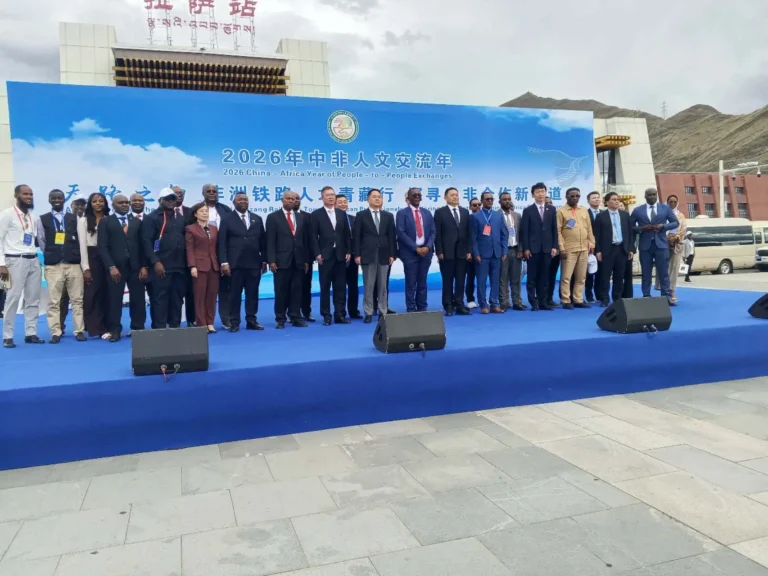
Railway experts from seven African countries have joined a knowledge exchange programme with China, studying high-altitude engineering on the Qinghai-Xizang Railway as it marks 20 years of full operation to Lhasa. The initiative, called the African Railway Talent Qinghai-Xizang Tour, signals a shift in China-Africa railway cooperation from simply building infrastructure to transferring the technical skills needed to operate it independently.
For Kenya, a country whose Standard Gauge Railway was built with Chinese financing and expertise, this exchange programme carries direct relevance. It points toward a future where Kenyan railway professionals could gain similar access to specialised training that strengthens local operational capacity rather than permanent dependence on foreign technical support.

What the Qinghai-Xizang Railway Has Achieved
The Qinghai-Xizang Railway, known as the Sky Road, began full operations to Lhasa on July 1, 2006. Two decades later, Lhasa West Railway Station handles an annual cargo throughput exceeding 6.59 million tonnes, managing over 350 trucks daily, a scale of freight movement that has transformed the regional economy.
The railway has directly increased per capita net income for local farmers and herders by integrating regional logistics into national supply chains. Connecting lines like the Lhasa-Nyingchi railway have seen peak monthly passenger volumes reach 153,800, demonstrating how rail infrastructure drives both cargo movement and tourism simultaneously.
From Building Railways to Operating Them
The forum’s core purpose is transitioning China-Africa railway cooperation beyond infrastructure construction toward local, independent operational management. This distinction matters enormously for African countries that have received Chinese-built rail infrastructure but have historically relied heavily on Chinese technical staff to keep those systems running.
Also read:South African Firms Bet Sh413 Billion on Kenya Blue-Chip Acquisitions
Delegates undertook a 21-hour journey from Lhasa to Xining to study complex plateau engineering systems firsthand, including permafrost stabilisation techniques that protect tracks against extreme temperature shifts, environmental protection strategies such as wildlife corridors, and the mechanics of oxygen-enriched coaches that operate safely above 5,000 metres altitude.
Why This Matters for Kenya’s SGR
Kenya’s Standard Gauge Railway, connecting Mombasa to Nairobi and onward to Naivasha, was built with significant Chinese financing and technical expertise through China Road and Bridge Corporation. Since operations began, questions have persisted about how much operational and maintenance capacity has genuinely transferred to Kenyan railway staff versus how much remains dependent on Chinese technical support.
This exchange programme offers a template for closing that gap. If Kenyan railway engineers and technicians gain access to specialised training programmes similar to what the seven participating African countries received on the Qinghai-Xizang line, it could accelerate the timeline for Kenya Railways Corporation to fully own SGR operations, maintenance, and long-term engineering decisions without ongoing reliance on external technical staff.
Environmental and Engineering Lessons Kenya Can Apply
The environmental protection frameworks studied during the exchange, including wildlife corridor design, carry particular relevance for Kenya given the ongoing debate around SGR’s impact on wildlife migration routes through Tsavo National Park. Chinese engineering solutions developed for the ecologically sensitive Tibetan plateau could offer transferable lessons for managing rail infrastructure through Kenya’s protected conservation areas.
The permafrost stabilisation expertise is less directly applicable given Kenya’s tropical climate, but the broader principle of engineering infrastructure specifically adapted to local geographical and environmental conditions, rather than applying a single standard blueprint everywhere, is a lesson with universal value for Kenya’s ongoing rail expansion plans.
The Bigger Regional Trade Picture
According to assessments from the Forum on China-Africa Cooperation, this collaboration aims to solve complex geographical challenges specifically for landlocked East African nations. That framing places Kenya in an interesting position. While Kenya itself has coastal access through Mombasa, its SGR functions as a critical trade corridor for landlocked neighbours including Uganda, Rwanda, and South Sudan.
Discussions during the forum focused on pairing rail networks with well-sequenced industrial park models, aiming to lower transit costs and boost sustainable local manufacturing rather than simply replicating Chinese blueprints wholesale. For Kenya, this approach aligns closely with the government’s own manufacturing growth targets and the industrial parks strategy already underway through the State Department for Industry. A more efficient, locally operated SGR that connects seamlessly with industrial development could meaningfully strengthen Kenya’s position as East Africa’s logistics and manufacturing hub.