






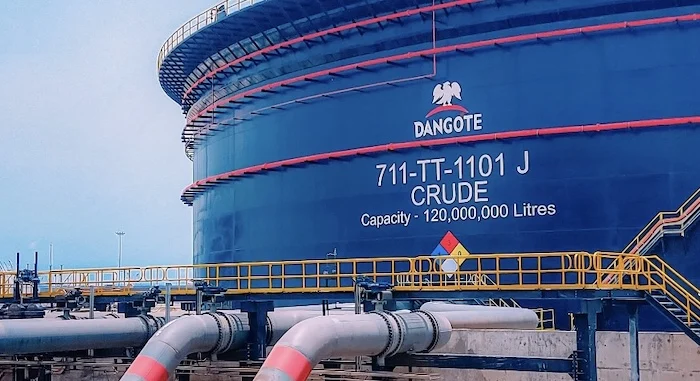
Nigeria’s Dangote Petroleum Refinery has purchased its first two crude oil cargoes from the United Arab Emirates, marking the facility’s first-ever feedstock acquisition from a Middle Eastern supplier. The move signals a significant strategic shift for Africa’s largest refinery as it scales toward peak capacity and seeks to diversify beyond domestic Nigerian crude.
The deal was made possible by an interim peace agreement between the United States and Iran that secured trade transit through the Strait of Hormuz, the critical shipping corridor through which roughly 21 percent of global oil trade flows. Without that agreement, sourcing Middle Eastern crude would have carried significantly higher logistical and geopolitical risk.
Why Dangote Is Looking Beyond Nigerian Crude
The refinery was engineered primarily to process domestic Nigerian light sweet crude, and a standing agreement with the Nigerian National Petroleum Company guarantees between 13 and 15 domestic cargoes monthly, paid in Naira. That arrangement was designed to anchor the refinery’s feedstock supply close to home.
But operational bottlenecks at Nigerian export terminals and domestic availability constraints have restricted consistent crude volumes reaching the facility. As Dangote Refinery scales toward its 700,000 barrel per day capacity, domestic supply alone cannot reliably meet the volumes required to run at full operational efficiency.
The Case for Heavier, Cheaper UAE Crude
Refinery CEO David Bird and founder Aliko Dangote have both signalled intentions to introduce heavier crude grades into the processing mix as a cost reduction strategy. UAE crude fits that profile, offering a cheaper feedstock option that, when blended with lighter Nigerian grades, can lower overall production costs without sacrificing refinery output quality.
For a facility competing to supply fuel across Africa and beyond, managing feedstock costs is as important as managing refining capacity. The UAE purchase reflects a maturing operational strategy rather than a departure from the refinery’s original design intent.
What This Means for Kenya and East Africa
For Kenyan consumers already struggling with high fuel prices, developments at the Dangote Refinery carry direct relevance. Kenya imports virtually all of its refined petroleum products, and the prices paid at petrol stations in Nairobi are directly connected to global crude oil dynamics and refining capacity across the region.
Current pump prices in Nairobi, as set by the Energy and Petroleum Regulatory Authority, stand at KSh 214.03 per litre for super petrol and KSh 222.86 per litre for diesel. Many Kenyan households and small businesses are finding these prices increasingly difficult to absorb, particularly as transport costs feed through into food prices and the broader cost of living.
Read also:Dangote Refinery Hits 700,000 Barrels Per Day, Eyes 1.4 Million Capacity
A fully operational Dangote Refinery, producing refined products at scale and supplying African markets, could over time reduce Kenya’s dependence on expensive imports from Europe and Asia. The refinery has already been exporting fuel to several African countries, and as its output grows, East Africa becomes a more natural target market given the proximity and shared regional trade infrastructure.
The Bigger Regional Picture
Dangote’s UAE crude purchase reflects the complex global supply chain that ultimately determines what Kenyans pay at the pump. Middle East geopolitics, Nigerian terminal capacity, refinery scaling decisions, and global crude pricing all feed into a system where the end consumer in Nairobi has no direct control but absorbs every fluctuation in their daily budget.
The Kenyan government’s KSh 21.5 billion fuel stabilisation fund, announced alongside the Finance Bill 2026, is designed to cushion consumers from the worst of those fluctuations. But structural relief, the kind that comes from regional refining capacity reducing import dependence, is what Kenya ultimately needs. Dangote’s expansion, if it continues at the pace its recent milestones suggest, moves that structural relief closer to reality for East African consumers.