









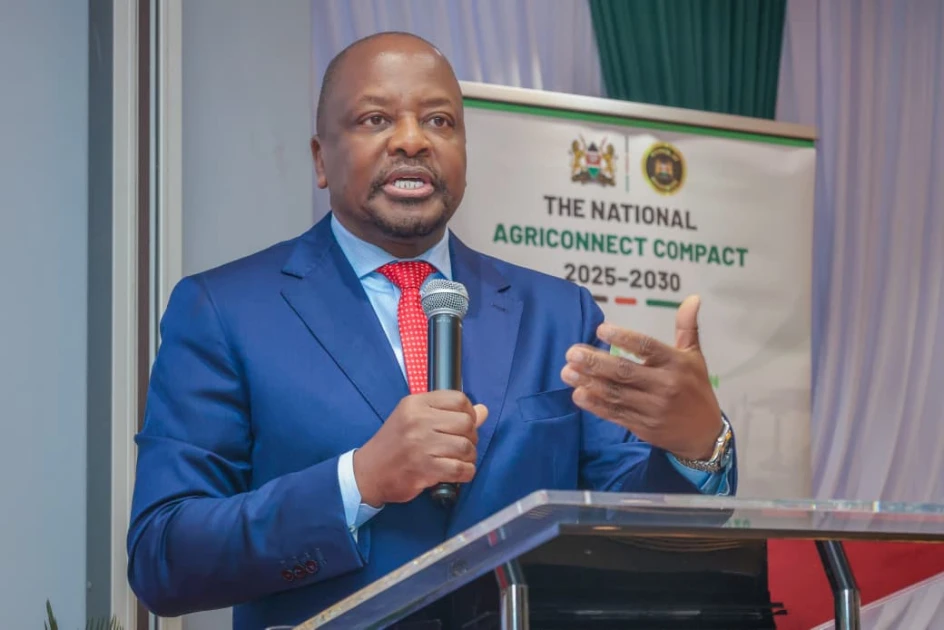
Agriculture CS Mutahi Kagwe has officially launched the Kenya AgriConnect Compact, a Ksh1.47 trillion initiative that aims to transform Kenya’s agricultural sector into a technology-driven, climate-smart economic engine over the next five years. The programme, running from 2025 to 2030, is one of the largest agricultural investments in Kenya’s history and comes backed by a combination of government funds, private capital, and major international development partners.
The scale of the ambition matches the scale of the problem. Kenya’s agricultural sector feeds millions but loses enormous value to food imports, post-harvest losses, and underdeveloped value chains. The AgriConnect Compact is designed to attack all of those weaknesses simultaneously, with a clear deadline and measurable targets attached to every objective.
How the Ksh1.47 Trillion Will Be Funded
The financing structure is built around a blended model designed to reduce investment risk and attract private capital at scale. The government is committing Ksh492.5 billion in catalytic public funding to anchor the initiative and signal long-term state commitment to the sector.
Private sector investment is expected to contribute Ksh984.9 billion, more than double the public component. To unlock that level of private capital, the programme is backed by the World Bank Group, the International Fund for Agricultural Development, the African Development Bank, and the Gates Foundation. That combination of institutional backing gives the initiative credibility with private investors who need confidence that the framework is stable before committing capital at this scale.
Cutting Food Imports and Boosting Exports
Two of the programme’s headline targets go directly at Kenya’s trade balance in agricultural commodities. The plan aims to slash expensive staple food imports, including maize and rice, by 50 percent over five years. At the same time it targets a 60 percent boost in high-value agricultural exports to global markets.
Those two targets work together. Producing more food locally reduces the import bill, while improving quality and processing standards opens export markets that currently reject Kenyan produce due to inconsistent quality or inadequate certification. Both outcomes require the same underlying investment in technology, infrastructure, and farmer training that the compact is designed to deliver.
Tackling Post-Harvest Losses
Kenya loses a significant portion of its agricultural output every year to poor post-harvest handling. Crops that survive from seed to harvest are lost to inadequate storage, poor transport infrastructure, and the absence of local processing facilities that could extend shelf life and add value before produce reaches the market.
The AgriConnect Compact specifically targets this through the deployment of advanced localised processing technologies and agritech systems. Getting this right is arguably more impactful than simply growing more. A farmer who loses 30 percent of their harvest post-production needs better processing infrastructure as much as they need better seeds or fertiliser.
Dairy, Edible Oils and Horticulture in Focus
The programme prioritises value chain development in three sectors where Kenya has strong production foundations but underdeveloped processing and marketing infrastructure. Dairy, edible oils, and horticulture are all identified as high-priority sectors where investment in processing, cold chain logistics, and market linkages can translate quickly into improved farmer incomes.
Read also:How Kirinyaga Became Kenya’s Gold Standard for Coffee Farming
Kenya’s Ministry of Agriculture has previously identified these same sectors as key drivers of agricultural GDP growth. The AgriConnect Compact now puts serious capital behind that identification, giving implementing agencies the resources to move beyond planning into actual infrastructure development and market building.
2.48 Million Jobs by 2030
Perhaps the most closely watched target in the entire compact is employment. The programme aims to create 2.482 million jobs by 2030, specifically designed to absorb Kenyan youth into modernised agricultural careers across agro-processing, digital supply chains, logistics, and agribusiness management.
Kenya’s youth unemployment challenge is one of the country’s most urgent economic and social problems. A programme that creates nearly 2.5 million jobs in five years, if it delivers, would represent one of the most significant employment interventions the country has ever undertaken. The agricultural sector, often dismissed as a low-skill, low-income option for young people, is being repositioned here as a destination for technology-enabled, professionally managed careers worth choosing.
Will It Deliver?
The ambition of the Kenya AgriConnect Compact is not in question. What matters now is implementation. Kenya has a history of well-designed agricultural programmes that underdeliver due to procurement delays, coordination failures between national and county governments, and private sector partners who commit capital in principle but hesitate when ground-level conditions prove harder than projected.
The involvement of the World Bank and other major multilateral partners introduces accountability mechanisms and technical expertise that domestic programmes sometimes lack. Whether that is enough to convert a Ksh1.47 trillion plan into measurable outcomes for Kenyan farmers, traders, and young jobseekers will be the real story to follow over the next five years.